
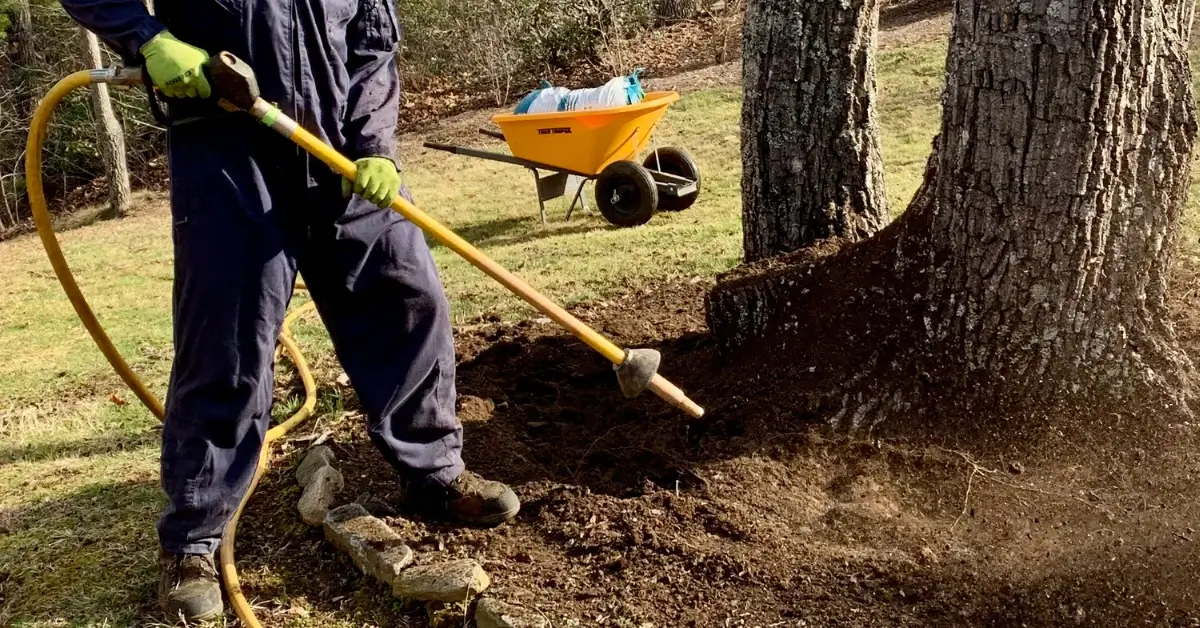
Airspade services can significantly improve soil conditions for trees. Root collar excavation and soil aeration are the most common airspade services.
Root collar excavation addresses the problems associated with a buried root flare, described earlier. Sometimes the site will not permit a complete root collar excavation service, but even a partial excavation of a buried root flare can provide essential stress relief.
Rootzone aeration is always advised if soil conditions are compacted. This service is applied via one of two techniques: radial trenching and vertical mulching.
Radial Trenching
Radial trenching involves making straight-lined trenches, radially from the trunk in all directions. These trenches can range in width and depth, but in compacted soil, a typical trench may be 2-4 inches wide, and 6-18″ deep. The length of the trenches depends on client preference and budget. The longer the better, up to the dripline. The spacing between trenches should be narrow; the more of the rootzone affected, the better. Deeper, wider, and longer trenches are obviously better, but also more demanding on labor and materials. Trenches must be kept wet to avoid desecration of the roots until they can be back filled with another medium (something beneficial to the tree, like compost or nutrient-enriched backfill). If mulch is to be applied afterwards on top of the backfilled trenches, this aeration technique is the ideal choice. However, if mulch is not to be applied, the final product of dark rays around the tree may be considered unsightly.
Vertical Mulching
Vertical mulching involves pointing the airspade straight down and excavating deep columns that are only a couple inches in width. The operator makes the columns in a grid pattern or as layered rings throughout the rootzone, to the extent of the client’s preference and budget. These columns are then filled with compost, biochar, or an enriched back fill. The benefits of vertical mulching is that it does not create a mess. The operator can even use a traffic cone to retain the excavated soil and prevent flying debris (ideal for urban areas). The roots are also not likely to dry out during the process, as the aeration holes are not as open to the air as radial trenches. The end result of the aeration is minimally disruptive to the pre existing landscape. Within turfgrass, the aeration holes are barely noticeable. The drawbacks are that vertical mulching does not affect as much of the rootzone and requires more labor time for both the airspade operator and the backfill team. For this reason, vertical mulching is less cost effective than radial trenching if serious rootzone improvement is required. It is, however, a much better alternative to no aeration service at all.